

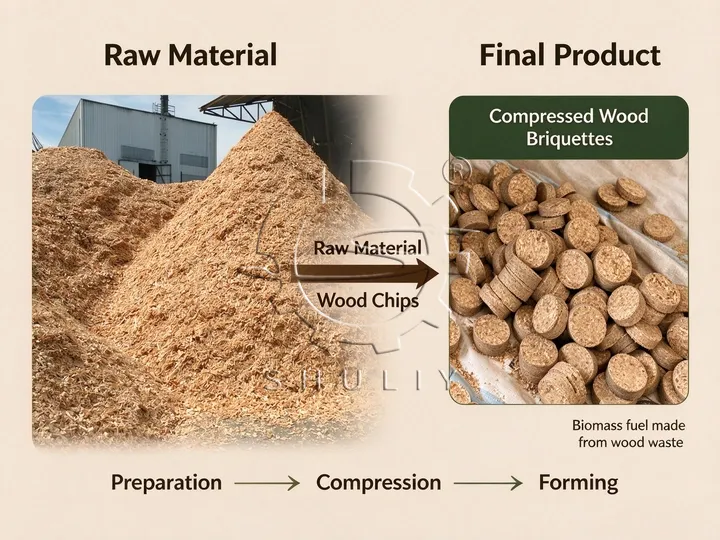
Sawdust and other wood-processing residues can be converted into compact biomass fuel through mechanical compression. A hydraulic sawdust briquette machine presses prepared wood material into solid blocks, making it easier to handle, store, and transport.
The process depends on several factors, including raw material moisture, particle size, compression conditions, and the machine’s forming structure.
Preparing wood waste for briquetting
Before entering the machine, sawdust must meet the requirements of the briquetting process. Different raw materials may require different preparation steps.
- Particle size: Oversized wood chips may need crushing to achieve a more uniform feed material.
- Moisture content: Excess moisture can affect compression and briquette stability. The appropriate moisture level depends on the machine and raw material.
- Contaminant removal: Stones, metal pieces, and other hard impurities should be removed to protect the equipment.
Proper preparation helps maintain stable feeding and reduces variations in the finished briquettes.
How does a hydraulic sawdust briquetting machine form solid fuel?
The loose sawdust into a denser shape. The machine’s forming mechanism determines the final briquette dimensions and structure.
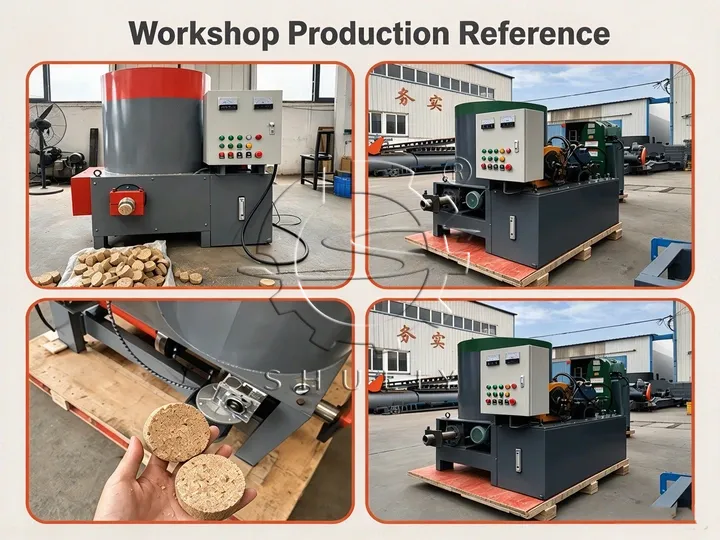
For a hydraulic sawdust briquette press, the hydraulic system drives a pressing mechanism that applies pressure to the material inside the forming chamber. As the material is compressed, loose particles are consolidated into a solid cylindrical block.
What affects the quality of sawdust briquettes?
Even when using the same hydraulic sawdust briquetting machine, changes in raw materials and operating conditions can lead to different results.
- Moisture content: Material that is too wet may produce weak or unstable briquettes, while material that is too dry may not bind effectively under certain forming conditions.
- Particle size: Uniformly prepared material generally feeds and compresses more consistently than a mixture containing widely varying particle sizes.
- Compression conditions: Pressure, pressing time, and the forming structure influence how tightly the material consolidates. These parameters should match the characteristics of the raw material.
- Machine condition: Worn forming components, irregular feeding, or incorrect settings may affect briquette shape and production stability. Regular inspection helps maintain consistent operation.
Checking these factors during production can help reduce broken briquettes and unnecessary material waste.
Where can solid sawdust briquettes be used?
Sawdust briquettes can serve as biomass fuel in suitable heating applications, including certain industrial boilers, furnaces, and other solid-fuel heating systems.
Compared with loose sawdust, compact briquettes by hydraulic briquetting machine are generally easier to package, stack, and transport. Their uniform shape can also make feeding and handling more convenient.
Turn wood waste into usable biomass fuel with Shuliy
Choosing the right hydraulic sawdust briquetting machine begins with understanding your material, production target, and fuel requirements.
Contact Shuliy with your raw material type and approximate moisture. Our team can help you evaluate the processing requirements and discuss a suitable solution for your biomass fuel production project.