Wet sawdust is commonly used in wood pellet production, biomass briquette manufacturing, and charcoal processing. However, excessive moisture can affect material feeding, forming, and subsequent processing. An airflow dryer provides a practical way to reduce sawdust moisture content before further use.
Why does sawdust need to be dried before processing?
The moisture content of sawdust directly affects its suitability for different processing operations.
- Wood pellet production: Excessive moisture can affect pellet forming and the quality of finished pellets.
- Biomass briquette production: Wet materials may affect compression and forming stability.
- Charcoal production: Remove excess moisture before carbonization helps prepare the raw material for the heating process.

Why choose an airflow drying machine for sawdust?
An airflow dryer machine is designed for small and lightweight particles that can be carried by hot air through a pipeline. Compared with drying equipment that uses a rotating drum, it has several characteristics suitable for prepared sawdust.
- Combines material transportation and drying: The blower carries hot air and sawdust through the drying pipeline. During transportation, the particles come into contact with hot air, allowing moisture to evaporate.
- Suitable for small-sized sawdust: The airflow dryer is suitable for materials with a particle diameter below 3 mm and a length below 5 mm. This makes it appropriate for processed sawdust and other small-sized biomass materials.
How does an airflow sawdust dryer work?
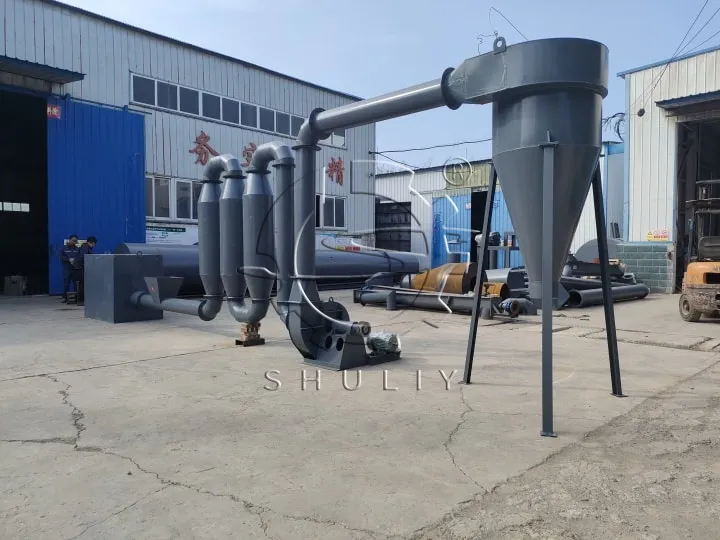
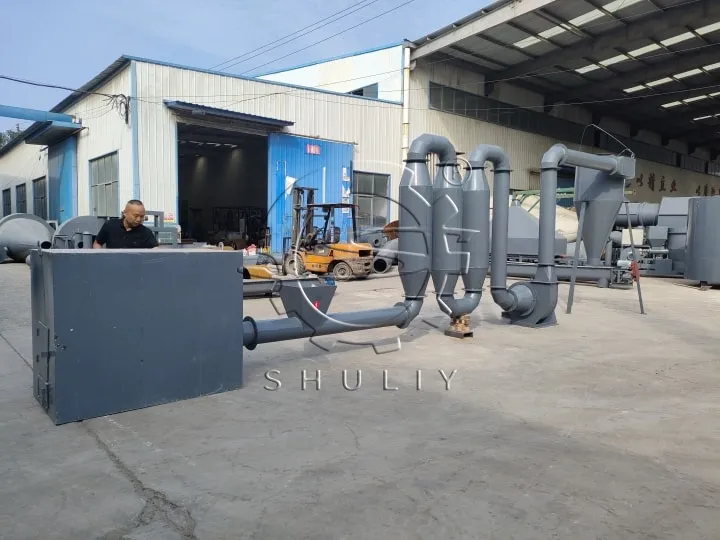
The airflow drying machine mainly consists of a heating furnace, feeding hopper, slag discharge outlet, material stirring device, drying pipeline, blower, support frame, and cyclone separator.
The working process includes four main steps:
- Wet sawdust enters the feeding hopper.
- The blower carries hot air into the drying pipeline.
- Sawdust travels through the pipeline and loses moisture through contact with hot air.
- The cyclone separator separates and collects the dried material from the airflow.
Is an airflow dryer suitable for your materials?
Before choosing an airflow drying machine, customers should consider several factors:
- What type of raw material will be dried?
- What is the initial moisture content?
- What final moisture content is required?
- Does the material meet the particle size requirements?
- What is the required processing capacity?
- Which heating fuel is available?
These details help determine whether an airflow dryer is suitable and which equipment configuration should be selected.
Contact us now for a solution!
Shuliy supplies airflow drying machines for sawdust, rice husks, and other suitable biomass materials. Contact us with your raw material type, moisture content, and required processing capacity to get equipment details and drying solutions.